





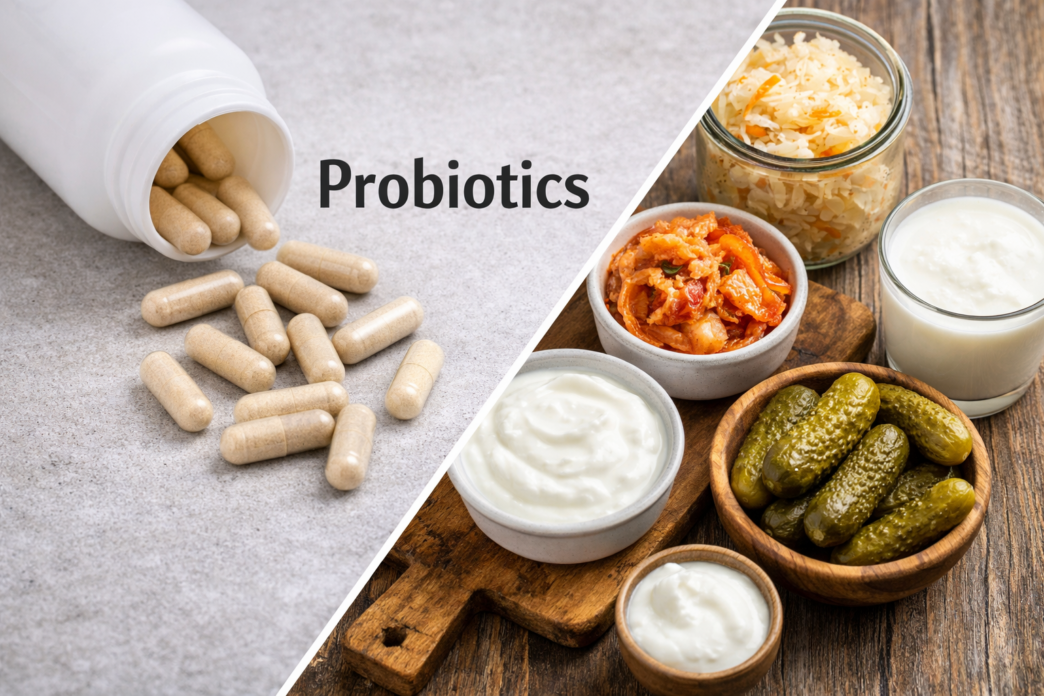
Probiotics Good or Bad? What You Really Need to Know
Are probiotics good or bad?
That question comes up constantly.
However, the answer is not simple.
The answer to the question “Probiotics good or bad?” depends on your gut, your immune system, and your current imbalances.
Many people take probiotics daily. Meanwhile, others feel worse after starting them. Therefore, instead of blindly supplementing, we need to understand what probiotics actually are.
In my own journey with Hashimoto’s and autoimmune gastritis, probiotics became very personal. As I explain in From Pain to Wellness: Overcoming Autoimmune Diseases, an Undisclosed Epidemic, healing starts with understanding the root cause, not chasing trends.
So let’s break this down clearly.
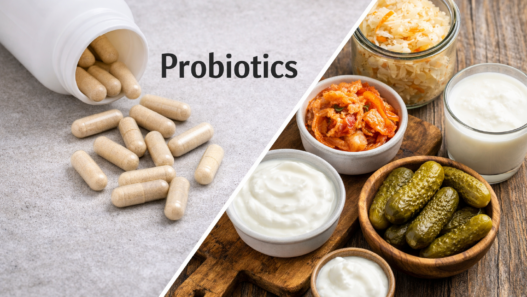
Understanding the Main Types of Probiotics
To answer the question “Probiotics good or bad?”, we must first understand the types of probiotics available.
There are four main groups:
1. First, lactic acid bacteria.
This group includes Lactobacillus and Bifidobacterium species. These are the most common strains found in supplements.
2. Second, yeast probiotics.
The most studied yeast probiotic is Saccharomyces boulardii. Unlike bacterial probiotics, this is a beneficial yeast wildly recommended for diarrhea, also known as Traveler’s diarrhea.
3. Third, spore forming probiotics.
These include Bacillus coagulans and other Bacillus species. They survive stomach acid better because they form protective spores.
4. Finally, next generation probiotics.
Examples include Akkermansia muciniphila and Faecalibacterium prausnitzii, which are still being researched.
Therefore, the question “Probiotics good or bad?” cannot be answered without knowing which type we are discussing.
Are Probiotics Good or Bad for IBS, Antibiotics, and Diarrhea?
Research shows that probiotics are either good or bad depending on the condition.
For example, a study published in Pubmed concluded that probiotics reduced the risk of C.Difficile-associated diarrhea in patients taking antibiotics. Probiotics for the prevention of Clostridium difficile-associated diarrhea in adults and children – PubMed
Similarly, Saccharomyces boulardii has shown benefits in preventing recurrent Clostridium difficile infections. A randomized placebo-controlled trial of Saccharomyces boulardii in combination with standard antibiotics for Clostridium difficile disease – PubMed
However, not all probiotics help IBS. In fact, some people with SIBO experience increased bloating after taking certain Lactobacillus strains.
So “probiotics good or bad” is often strain specific. One strain may help diarrhea while another may worsen gas.
That is why random high dose blends are not always helpful.
Are Probiotics Good or Bad in Autoimmune Conditions?
A lot of people with autoimmune diseases such as Hashimoto’s, Autoimmune Gastritis, Lupus and others are prescribed automatically probiotics.
It seems logic since the majority of the immune system lives in the gut. Therefore, gut imbalance can influence autoimmune activity. A review in Frontiers in Immunology highlights the link between microbiota and autoimmune diseases. Frontiers | Leaky Gut As a Danger Signal for Autoimmune Diseases
However, adding probiotics does not automatically fix immune dysregulation.
In my book From Pain to Wellness: Overcoming Autoimmune Diseases, an Undisclosed Epidemic, I explain that healing the gut requires removing triggers first. That may include bacterial overgrowth, parasites, yeast, stress, or food sensitivities.
If the terrain is inflamed, adding bacteria may not solve the deeper issue.
Therefore, the answer to “Probiotics good or bad?” depends on whether the gut environment is ready or not.
Probiotics Good or Bad? Do We Really Need Them?
Here is the honest truth: asking if Probiotics are good or bad is the wrong question. A better question is this: What does your gut need?
A study published in Cell showed that probiotic colonization varies significantly between individuals. Post-Antibiotic Gut Mucosal Microbiome Reconstitution Is Impaired by Probiotics and Improved by Autologous FMT: Cell.
In other words, some people respond well. Others do not.
Personally, only Saccharomyces boulardii made a clear difference for me and this only when I had a looser stool while traveling. Most other probiotics did nothing or increased bloating. That experience taught me something important.
Your microbiome is unique.
Therefore, the answer to “Probiotics good or bad?” cannot be universal.
Sometimes the priority is stomach acid.
Sometimes it is bile flow.
Sometimes it is removing infections first.
So should we take probiotics?
Sometimes yes.
Sometimes no.
Always personalized!
How to Choose Your Probiotic
When asking “Probiotics good or bad?”, the next logical step is learning how to choose your probiotic wisely.
First, do not choose based on CFU count alone. More billions does not mean better results. In fact, higher doses can worsen bloating in sensitive individuals.
Second, choose based on your condition. For example, Saccharomyces boulardii is often helpful during and after antibiotics or for certain types of diarrhea. On the other hand, some Lactobacillus strains may support vaginal health. Meanwhile, certain Bifidobacterium strains are better studied in constipation dominant IBS.
Third, read the strain, not just the species. Lactobacillus rhamnosus is not enough information. The strain, such as GG, matters because research is strain specific. A review in World Journal of Gastroenterology highlights that probiotic effects are strain dependent, not universal. Effects of probiotics on gut microbiota: mechanisms of intestinal immunomodulation and neuromodulation – PMC.
Fourth, consider your gut terrain. If you suspect SIBO, yeast overgrowth, or significant dysbiosis, probiotics good or bad becomes more complicated. In those cases, removing the imbalance first may be more important than adding bacteria.
Also, start low and go slow. Introduce one strain at a time. Then monitor symptoms for at least two weeks.
Finally, remember what I share in From Pain to Wellness: Overcoming Autoimmune Diseases, an Undisclosed Epidemic. Gut healing is layered. We remove triggers. We repair the lining. Only then do we rebalance.
So probiotics good or bad is not about the brand.
It is about strategy.
Final Thoughts on "Probiotics Good or Bad?"
Probiotics can be good or bad depending on your microbiome, your diagnosis, and your root cause.
Although probiotics can be helpful in specific cases, they are not magic pills. Moreover, more bacteria does not automatically mean better health.
Gut healing is layered. First remove. Then repair. After that, rebalance.
If you are struggling with bloating, Hashimoto’s, autoimmune gastritis, or IBS, testing is far more powerful than guessing.
Because at the end of the day, “Probiotics good or bad?” is not about the supplement.
It is about your terrain.